Uncorking the City: NYC's Indie Perfumers Are Making Scents Out of This Place
Let's be honest: New York City smells like a lot of things, and not all of them are flattering. Hot garbage on a July afternoon in the Meatpacking District. The metallic exhale of a B train pulling into DeKalb Avenue. Roasted nuts from a corner cart, cut with bus exhaust. Wet pavement after the first real rain of September.
But here's the thing — those smells are ours. And a growing community of independent perfumers across the five boroughs has decided that the scent of this city, in all its chaotic, layered, occasionally offensive glory, deserves to be bottled.
More Than Just Cologne
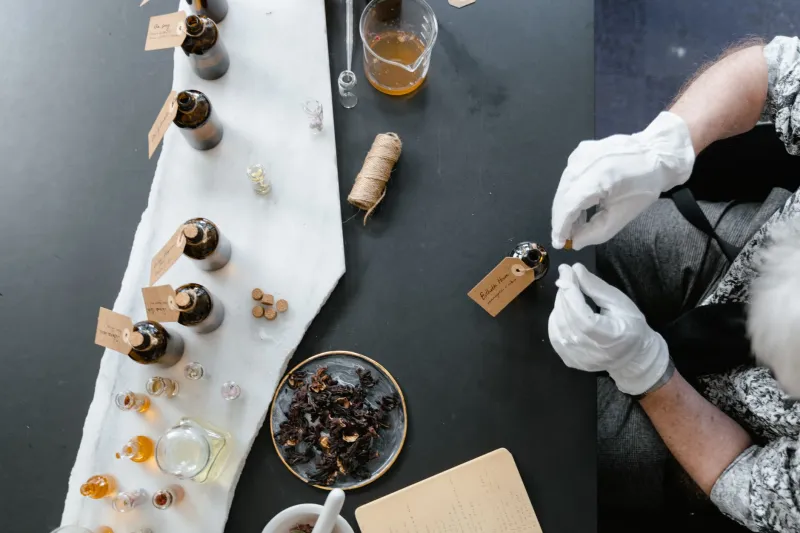
This isn't about luxury fragrance houses doing a "New York-inspired" limited edition. We're talking about small-batch makers — many of them working out of home studios, shared workshops, or rented corners of Brooklyn labs — who are approaching scent as a form of cultural documentation. Think of it like field recording, but for your nose.
Take Mirela Voss, who runs a one-woman operation called Canal Street Apothecary out of her Chinatown apartment. Her flagship scent, Eight and a Half, is named for the approximate number of blocks she walks every morning from her front door to the Canal Street station. The formula layers dried osmanthus (a nod to the flower markets along Mott Street), something she describes as "warm concrete," and a faint trace of incense drifting from a Buddhist temple two blocks east.
"People smell it and they immediately know where they are," she says. "Even if they've never lived in Chinatown. There's something in the human brain that connects scent to place faster than any photograph can."
She's not wrong. Neuroscientists have long noted that olfactory memory is processed through the brain's limbic system — the same region that handles emotion and long-term memory. Scent doesn't just remind you of a place. It returns you to it.
Neighborhood as Raw Material
Across the city, indie perfumers are treating specific blocks, transit lines, and micro-communities as source material. Marcus Thibodeau, a former jazz musician turned fragrance maker based in Bed-Stuy, has built a small but intensely loyal following around his line Brownstone Season. His scents are named for streets and intersections — Nostrand at Dusk, Halsey in July, The Corner Where the Old Barbershop Was — and each one is informed by obsessive neighborhood walks, conversations with longtime residents, and what he calls "sensory journalism."
"I interview people," he explains. "I ask them what their block smells like in different seasons. What their grandmother's kitchen smelled like. What the stoop smelled like after it rained. And then I try to translate that into something you can carry with you."
The results are striking. Nostrand at Dusk opens with something smoky and warm — charcoal from a nearby restaurant's exhaust, Marcus says — and settles into a deep, woody base that he associates with old crown molding and sun-warmed brick. It's not a "pretty" scent in the conventional sense. It's a real one.
Collaborations That Actually Make Sense
What's particularly exciting about this scene is how it's weaving itself into the broader fabric of NYC's independent business ecosystem. These perfumers aren't just selling online or at weekend markets — they're building genuine partnerships with local institutions.
Mirela recently collaborated with a Chinatown tea shop to create a limited-edition scent sold exclusively in their store. Marcus partnered with a Bed-Stuy record shop to release a fragrance tied to a vinyl compilation of local musicians — buy the record, get a sample vial. Another maker, Priya Okonkwo of Subway Alchemy (yes, she's really doing this), worked with a Queens cultural center to develop a scent that attempts to capture the sensory experience of the 7 train corridor — the so-called "International Express" — as it moves through Jackson Heights, Woodside, and Flushing.
"The 7 train is one of the most culturally dense stretches of transit in the world," Priya says, completely serious. "I wanted to make something that honored that. Cardamom, garlic, something floral, something fried, a little diesel. It's chaotic and it's beautiful and it smells like everywhere at once."
Her scent, Queens Boulevard, sold out in two weeks.
The Anti-Luxury Luxury
There's something quietly radical about what these makers are doing. High-end perfumery has always been associated with escapism — transporting you to a Provençal lavender field or a Moroccan spice market, somewhere other than where you are. NYC's indie perfumers are flipping that script entirely. The pitch isn't escape. It's presence. It's pride.
And in a city where displacement is constant — where neighborhoods change faster than you can mourn them, where longtime residents get priced out and institutions disappear overnight — there's something genuinely moving about the impulse to preserve a place through scent. A bottle of Halsey in July won't stop gentrification. But it holds something real. It says: this existed. This was here. This is what it smelled like.
The price points reflect the indie ethos, too. Most of these makers sell in the $30–$80 range for a 30ml bottle, with sample sets often available for under $20. They're not trying to compete with Byredo or Le Labo. They're building something different — a community around a shared sensory experience of a shared city.
Where to Find Them
If you want to explore this scene, start at weekend markets — Smorgasburg, the Brooklyn Flea, and various pop-ups in Bushwick and Harlem regularly feature indie fragrance makers. Follow the hashtag #NYCperfumers on Instagram for a rabbit hole of small-batch makers and their stories. Several makers also do "scent walks" — guided neighborhood tours where participants smell and discuss the olfactory landscape before the maker reveals how they translated it into a formula.
It's experiential, it's local, it's the kind of thing that couldn't exist anywhere else. Which, honestly, is the most New York thing we can say about it.
The city has always had a smell. Now it has people paying close enough attention to tell you exactly what it is.