Still Glowing After All These Years: Meet the New Yorkers Saving the City's Neon Soul
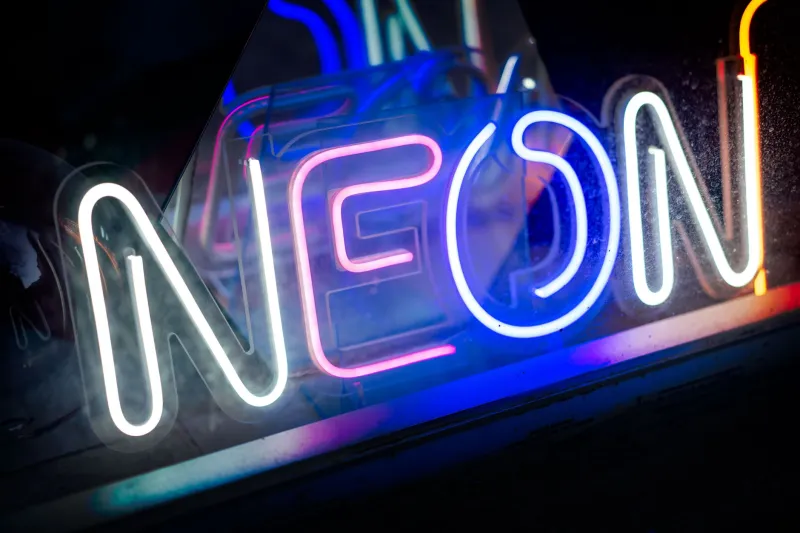
There's a particular kind of heartbreak that hits you when a beloved neighborhood spot shutters and the sign comes down. Not the building, not the awning — the sign. The one that buzzed and flickered in that specific shade of coral-pink every night for forty years. The one you never really noticed until it was gone and the storefront was suddenly just... dark.
For most of us, that's where the story ends. For a small, devoted community of New Yorkers, that's exactly where it begins.
The Hunt Is Half the Thing
Ask anyone deep in the neon restoration world how they got started and you'll hear some version of the same origin story: they saw something beautiful getting thrown away and couldn't let it happen. Tony Ferrara, who runs a restoration operation out of a cramped but immaculate Gowanus studio, found his first sign in a Dumpster on Atlantic Avenue back in 2009. It was a jeweler's sign — deep cobalt blue tubing spelling out a name that no longer meant anything to anyone except, apparently, him.
"I didn't even know how to fix it," he says, laughing. "I just knew I couldn't leave it there."
That impulse — call it collector's instinct, call it urban grief, call it straight-up stubbornness — is the engine behind a loosely connected network of sign hunters, glass benders, and light obsessives who spend their weekends crawling through estate sales in the Bronx, negotiating with demolition crews in Flushing, and trading leads in private online forums with names that sound more like secret societies than hobbyist groups. And in a city that tears itself down and rebuilds roughly every fifteen minutes, there's no shortage of material.
What It Actually Takes
Here's the thing most people don't realize about neon: it's not a dying art so much as a nearly lost one. The craft of bending glass tubes, filling them with noble gases, and coaxing them into glowing shapes is genuinely technical work. You're not just fixing a lightbulb. You're diagnosing a system — tracking down gas leaks, replacing electrodes, sourcing transformer components that haven't been manufactured since the Reagan administration, and sometimes re-bending entirely new sections of glass to match decades-old originals.
Maria Chen, one of a handful of women working in neon restoration in the city, trained under an old-school sign maker in Chinatown before going out on her own. She'll tell you that the hardest part isn't the glasswork — it's the detective work. "Every old sign is a puzzle," she explains. "You're trying to figure out who made it, what gas mixture they used, what the original color temperature was. Sometimes there are no records. You're just reading the glass."
The tools of the trade are a mix of antique and improvised: ribbon burners for heating and bending tubing, vacuum pumps for evacuating and refilling the glass with argon or neon gas, and an almost absurd amount of patience. A full restoration on a large mid-century sign can take weeks. The reward, when the transformer clicks on and the tubes light up for the first time in decades, is — by all accounts — genuinely transcendent.
Urban Amnesia and Why It Matters
There's a deeper argument being made here beyond aesthetics, and the people doing this work are pretty clear-eyed about it. NYC has a memory problem. Rapid gentrification, aggressive development, and the relentless turnover of commercial real estate means that entire visual vocabularies of neighborhoods can disappear in the span of a single lease cycle. The neon signs of the mid-twentieth century weren't just advertisements — they were the visual language of working-class commercial culture. Bodegas, bowling alleys, diners, dance halls, dry cleaners. The businesses that built neighborhood identity before the word "neighborhood" became a real estate marketing term.
When those signs vanish, something more than a business closes. A record gets erased.
Preservation efforts like the ones being carried out in these studios are, in a very real sense, acts of archival resistance. Several restorers have started photographing and cataloging signs before they're removed, building informal databases of what the city looked like block by block, decade by decade. Some have partnered with local historical societies. Others donate restored pieces to community organizations, schools, or small businesses that can't afford new signage but deserve something beautiful on their walls.
The New Generation Is Plugged In
What's genuinely surprising — and kind of thrilling — is who's showing up to learn. The people seeking out neon apprenticeships and restoration workshops in NYC right now skew younger than you'd expect. Twenty-somethings who grew up in the age of LED strips and digital displays are actively choosing to learn a craft that requires fire, gas, and a working knowledge of mid-century electrical systems.
Some of it is nostalgia, sure. Neon has had a visual moment in the culture — you've seen it on every Instagram aesthetic board and in every moody indie film for the past decade. But the people actually showing up to learn the craft seem motivated by something more grounded than trend-chasing. There's a hunger for work that's physical, irreducible, and genuinely skilled. Work where the result either glows or it doesn't.
"You can't fake this," says Ferrara. "The glass either holds the gas or it doesn't. It's honest in a way that a lot of modern work isn't."
Where the Signs End Up
The afterlives of restored neon are as varied as the city itself. Some pieces go to collectors — and yes, the market for vintage neon has gotten real enough that prices on exceptional mid-century pieces can run into the thousands. But many restorers are deliberate about keeping their work in public or semi-public spaces. Bars, community centers, independent record stores, barbershops. Places where the sign becomes part of the room's personality rather than a trophy in someone's living room.
A few pieces have even made their way back to something close to their original context — a restored pharmacy sign now hanging in a neighborhood health clinic, a dance hall marquee living in a Bronx cultural center that hosts weekend salsa nights. Those placements feel like completions of a circle.
The City Deserves to Remember Itself
New York is always in the process of becoming something new, and that's part of what makes it electric. But becoming doesn't have to mean forgetting. The neon restorers working in studios and garages across the five boroughs are making a quiet, stubborn argument: that the city's past is worth the effort of preservation, that beauty is worth rescuing from a Dumpster, and that a sign that glowed for forty years deserves at least a chance to glow for forty more.
Next time you walk past a buzzing neon sign in a dive bar or a corner shop, take a second. Someone probably fought to keep that light on. And the city is a little less dark for it.